The CIPMAF project aims to develop a component for nuclear fusion reactors using new materials and an intelligently controlled manufacturing process.
A component subjected to extreme conditions
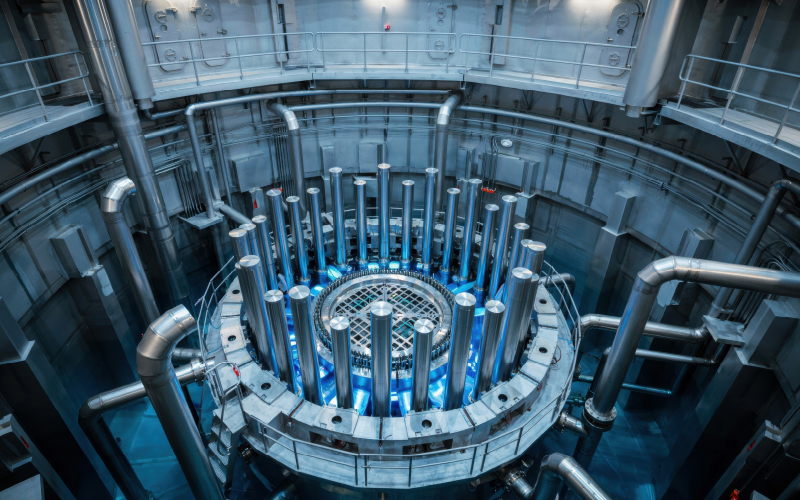
In nuclear fusion reactors, the divertor helps to manage heat and remove impurities from the plasma. Its components must withstand high temperatures and intense heat fluxes without losing their structural integrity. Tungsten is used on surfaces exposed to the plasma, but its brittleness and manufacturing difficulties pose challenges for the production of these components.
It is against this backdrop that CIPMAF – Intelligent Process Control for the Production of Advanced Materials via DED Technology Relevant to Nuclear Fusion – has emerged. The project is co-funded by COMPETE 2030 and brings together complementary expertise within a consortium led by Moldetipo II, which is responsible for management and manufacturing trials. AGIX contributes its expertise in automation, robotics and control systems; IPFN / IST is responsible for plasma physics and advanced materials characterisation; and INEGI focuses on additive manufacturing and mechanical modelling.
“The CIPMAF project is a pioneering initiative in the development of functionally graded materials (FGMs), based on high-entropy alloys, for the manufacture of divertor monoblocks in nuclear fusion reactors,” says Luís Lopes, CFO of Moldetipo.
A material that changes from layer to layer
The consortium aims to develop a material whose composition varies gradually between a copper alloy base – responsible for heat removal – and a tungsten surface, designed to withstand the conditions near the plasma. The use of high-entropy alloys in the intermediate layers is intended to improve mechanical strength and reduce the problems associated with bonding materials with different properties.
Production will be carried out using Directed Energy Deposition (DED), an additive manufacturing technology that allows material to be deposited in layers. The process requires rigorous control of the composition and printing conditions to produce parts with the desired properties and free from critical defects.
“To address the major thermal and mechanical challenge associated with the brittleness of tungsten under extreme conditions, the project utilises Direct Energy Deposition (DED) additive manufacturing technology, complemented by intelligent real-time control systems,” explains Luís Lopes.
Data to adjust the manufacturing process in real time
CIPMAF plans to use a thermal camera and other sensors to monitor the printing process. The data collected will feed into a control system capable of identifying deviations and automatically adjusting the equipment’s parameters. The team will also study and test the materials produced, including their structure, thermal conductivity and strength.
The work is expected to culminate in the production and validation of a monoblock prototype for the divertor. According to Luís Lopes, “The project aims to advance the technological maturity of the solution from the initial laboratory phase (TRL 2) to the validation of industrial prototypes in a relevant environment (TRL 6), positioning the national industry and scientific community at the forefront of the global energy transition.”