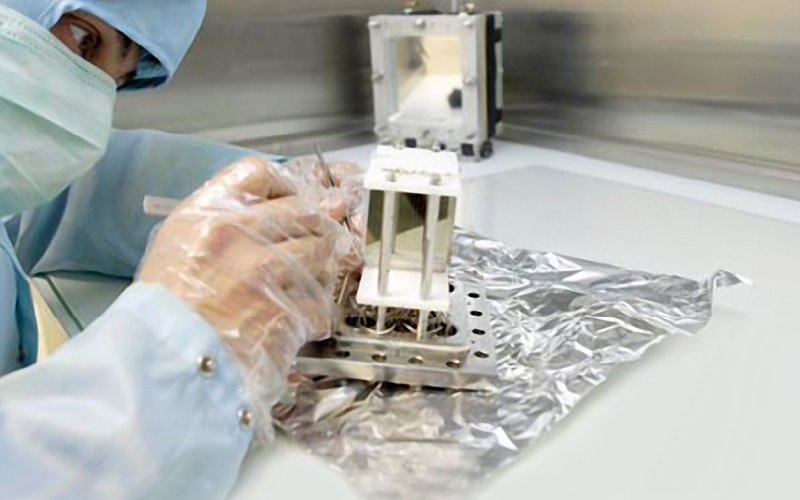
The LIPTec initiative brings the knowledge and technologies developed by LIP closer to businesses, with a particular focus on the North and Centre regions.
Knowledge with applications beyond the laboratory
Research in particle physics requires instruments, methods and technological solutions capable of addressing complex scientific questions. Some of this knowledge may also find applications in industry. It is this potential that the LIPTec initiative – Knowledge and Technology Transfer from LIP to Industry – seeks to develop.
Organised by LIP – the Laboratory of Instrumentation and Experimental Particle Physics – and co-funded by COMPETE 2030, the initiative aims to strengthen the link between the laboratory and the business community.
Raul Sarmento, coordinator of LIPTec, explains the starting point: “At LIP we carry out fundamental science. We study some of the major unresolved questions in physics, from the infinitely small to the infinitely large.”
This research brings together expertise that extends beyond the field of particle physics. In the coordinator’s words, “To this end, we work on major international scientific collaborations and develop technology in areas such as artificial intelligence, detection and monitoring systems, radiation engineering and multimedia tools. This technological component has always been part of LIP because, in experimental physics, it is often necessary to develop our own instruments, methods and solutions in order to answer the questions we wish to investigate.”
Technologies for different sectors
LIP identifies five areas with potential for technology transfer: data science and artificial intelligence; monitoring and control systems; detection instrumentation and electronics; radiation engineering and simulation; and advanced dissemination tools.
The potential applications are varied. Image analysis can aid in the identification of defects in industrial processes, whilst monitoring systems can be used in resource management or for tracking environmental parameters. The high-precision instrumentation developed at the laboratory also has potential in the fields of healthcare and industrial safety.
As Raul Sarmento observes, “And some of these solutions end up being of interest far beyond the problem for which they were originally designed.”
Some of the technologies identified by LIP are still at the stage of laboratory validation or demonstration in relevant environments. The initiative aims to create the conditions to develop this potential and bring the solutions closer to economically viable applications.
Closer links with businesses
Over the years, LIP has established collaborations with businesses and other organisations, including initiatives linked to CERN (the European Organisation for Nuclear Research). However, many of these contacts have resulted from the individual efforts of researchers. LIPTec aims to organise and expand this work through a Technology Transfer Office, which will act as a point of contact between the laboratory and businesses.
Raul Sarmento describes the origins of this initiative: “It was in this context, as part of a project funded by the COMPETE 2030 programme, that LIPTec, LIP’s technology transfer office, was established. With LIPTec, we have begun to take a more systematic look at this potential and to engage with companies and other organisations within the national innovation ecosystem. These discussions are already paving the way for new partnerships and collaborations.”
The initiative involves mapping skills and identifying companies with potential for collaboration, producing specialised promotional materials, organising events and supporting joint projects. It also aims to increase the number of technology transfer agreements and funding applications developed in partnership with companies.
With centres in Braga and Coimbra, LIP aims to strengthen the economic exploitation of scientific knowledge, particularly in the North and Centre regions. By building links with the business community, LIPTec seeks to build on existing collaborations and open up new opportunities to apply technologies arising from fundamental research.