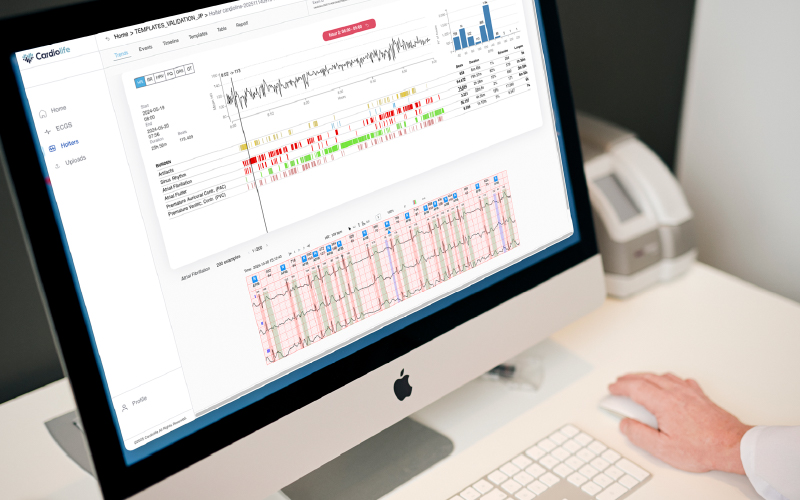
Cardiovascular diseases remain the leading cause of death worldwide, posing one of the greatest challenges to healthcare systems. Despite technological and clinical advances, early diagnosis and effective monitoring of these conditions remain crucial to improving treatment outcomes and reducing mortality. It is against this backdrop that the CLAdvanced – CardioLife Advanced project has been launched, led by Cardiolife in partnership with INESC TEC and Cardio-On, and co-funded by COMPETE 2030.
A new generation of diagnostic support tools
The project aims to develop an advanced solution for the detection, monitoring and prediction of heart disease through the use of Artificial Intelligence (AI). The initiative seeks to address some of the main limitations of current systems for analysing electrocardiograms (ECGs) and Holter monitors, thereby enhancing clinical decision-making support.
As João Pedro Leite, COO of Cardiolife, notes, “cardiovascular diseases remain the leading cause of death worldwide, and the electrocardiogram is still, today, the most commonly performed diagnostic test across the globe. It is at this intersection between the scale of the problem and the ubiquity of the test that CLAdvanced comes into its own.”
At present, the interpretation of ECGs and Holter monitors requires specialist knowledge and clinical experience and is subject to inter-observer variability and the availability of cardiologists. CLAdvanced aims to reduce these limitations through algorithms capable of automatically analysing the tests and providing clear, evidence-based information to healthcare professionals.
More accurate diagnosis and prediction of conditions
One of the main objectives of the project is to improve the ability to identify complex or rare cardiac conditions, which are often difficult to detect using conventional methods. Among the conditions targeted are syndromes such as Wolff-Parkinson-White, Brugada and Atrial Ectopic Rhythm, as well as complex cardiac events, including certain types of myocardial infarction and advanced heart block.
At the same time, the project places a strong emphasis on the predictive aspect. By analysing subtle patterns present in ECGs, the new AI models will seek to anticipate the development of conditions such as atrial fibrillation, enabling earlier and potentially more effective intervention.
According to João Pedro Leite, “At Cardiolife, we are developing a new generation of artificial intelligence algorithms for ECG and Holter analysis, with the aim of raising our software to a level of clinical performance that few players at European level are able to achieve, and doing so from Porto, in partnership with INESC TEC and Cardio-On.”
Continuous monitoring and integration of multiple data sources
Another innovative aspect of CLAdvanced involves the development of long-term monitoring tools capable of automatically analysing Holter recordings and identifying clinically relevant events within large volumes of data.
The project also envisages the integration of information from different devices, including consumer electronics such as smartwatches and fitness trackers. This approach will enable the creation of continuous monitoring systems and population-based screening solutions, contributing to the early detection of arrhythmias and other potentially serious cardiac conditions.
In addition, advanced visualisation tools and structured reports will be developed to enable clinicians to easily understand the rationale behind the conclusions presented by the algorithms, thereby boosting confidence in the use of these technologies.
The contribution of COMPETE 2030
The realisation of this technological and scientific ambition benefits from the support of COMPETE 2030, which is considered essential for accelerating the development of the solution and strengthening the international competitiveness of Portuguese technology in the field of digital health.
In this regard, João Pedro Leite emphasises that “The support from COMPETE 2030 is crucial for us to be able to embrace this project with the ambition it deserves. It enables us to invest in R&D, significantly expand our annotated clinical database, and accelerate the path to regulatory validation in key international markets. Without this framework, we would struggle to consolidate, within a 36-month timeframe, all the technical, clinical and regulatory components that are transforming CLAdvanced into a truly distinctive product.”
For the head of Cardiolife, the impact of this support goes beyond direct funding: “More than just funding, COMPETE 2030 gives us the stability we need to think long-term, build skilled teams and maintain a digital health innovation ecosystem in Portugal that is fully equipped to compete globally.”
Through CLAdvanced, the consortium aims to contribute to a new generation of smart solutions to support cardiology, combining technological innovation, scientific knowledge and clinical impact to improve the prevention, diagnosis and monitoring of cardiovascular diseases.