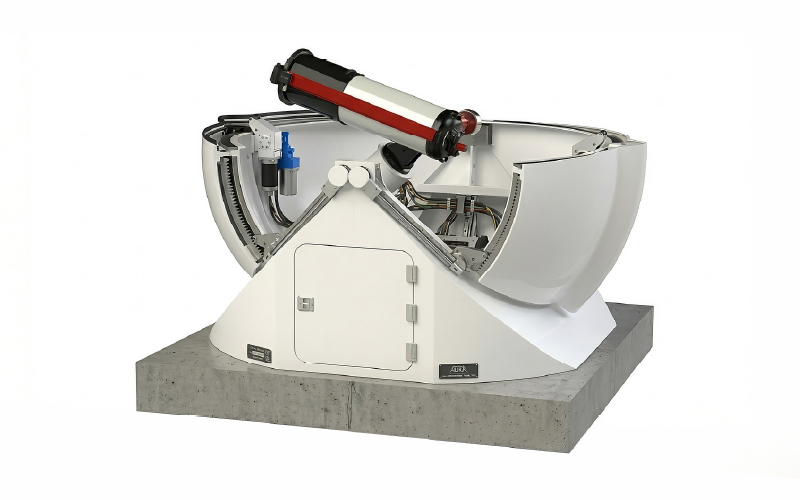
Atlar aims to put Portugal at the forefront of space surveillance
Technology developed in the interior of the country enhances the monitoring of objects in low Earth orbit, contributing to safer space traffic management.
A technology developed in the interior of the country aims to improve the monitoring of objects in low Earth orbit, contributing to safer space traffic management and positioning Portugal within a rapidly expanding sector.
Looking into space with greater precision
The number of satellites and objects in orbit continues to grow. Consequently, there is also a growing need for solutions capable of monitoring space more efficiently. It is against this backdrop that the Lopes project (LEO OPtical TelEscope for Space) has been launched, led by Atlar and co-funded by COMPETE 2030.
The initiative aims to research and develop an innovative solution based on advanced optical sensors for the monitoring and tracking of space objects in low Earth orbit (LEO). The objective is to create a new generation of lightweight, fast telescopes with a wide field of view, capable of collecting advanced data on the space environment.
According to Miguel Bergano, CEO of Atlar, “the support from COMPETE 2030 is a cornerstone of the Lopes project, enabling Atlar to research and develop a disruptive optical monitoring solution for low Earth orbits (LEO)”.
A global network to monitor space traffic
Atlar’s ambition goes beyond the development of a single piece of equipment. The company aims to create its own network of telescopes spread across different geographical locations, thereby significantly increasing coverage of orbital space.
This infrastructure will enable the monitoring of so-called Resident Space Objects (RSOs), providing essential information for space traffic management services. Furthermore, it will help to anticipate the risk of collisions and improve the safety of operations in orbit.
Although the focus is on low Earth orbits, the solution has been designed to maximise the use of the equipment. As LEO observations can only be carried out for a few hours before sunrise and after sunset, the telescopes will also be able to monitor objects in medium Earth orbits (MEO) and geostationary orbits (GEO) during the rest of the night.
As a result, the platform becomes more versatile, enhancing data collection capabilities and operational efficiency.
Technology developed in-house with global ambitions
The project also represents a strategic commitment to enhancing the region’s potential. The development of the technology into an advanced operational prototype will strengthen the country’s presence in a highly specialised sector of the space economy.
As Miguel Bergano points out, “this co-funding enables the technology to progress from an early stage of maturity to an advanced operational prototype (TRL 6/7), establishing the Pampilhosa da Serra region as a strategic European hub for the tracking of space objects and making a direct contribution to the EU-SST programme”.
At the same time, the initiative aims to create highly skilled jobs and support the company’s international expansion into markets such as Brazil and Australia.
Contributing to a safer and more sustainable space sector
The growth of the space economy calls for new solutions to ensure the safe use of Earth’s orbits. In this regard, the Lopes project seeks to address a strategic challenge for the future of space activities.
As well as strengthening national technological capabilities, the solution will contribute to the continuous monitoring of the orbital environment and to the provision of specialist data to the sector.
Miguel Bergano also emphasises that the project “is fully in line with the objectives of digital transition and sustainability in the space sector, ensuring that Portugal plays a leading role in the ‘zero-debris policy’ and in the security of critical infrastructure in orbit”.
By combining innovation, applied research and an international outlook, the Lopes project places Portugal amongst the countries seeking to develop technologies capable of making space safer, more sustainable and better equipped to meet the challenges of a new economy based on the responsible exploitation and use of space infrastructure.